
Hailstorms rarely give homeowners much warning. One moment the sky is clear, and the next, ice is pounding roofs, siding, windows, and vehicles. After the storm passes, many property owners immediately ask the same question: will insurance cover the damage? The answer depends largely on how insurance companies evaluate hail damage. Understanding how insurance companies evaluate hail damage before filing a claim can help you prepare better documentation, ask informed questions, and avoid surprises during the claims process. For homeowners in Euless, learning how insurers assess storm damage is one of the smartest investments you can make after severe weather.
Unlike what many people assume, insurance companies do not simply glance at a damaged roof and decide whether to pay for repairs. Every claim follows a structured process involving inspections, weather verification, policy interpretation, estimating software, and supporting documentation. Even properties sitting next door to each other may receive different claim outcomes because every home has unique characteristics. The good news is that once you understand the evaluation process, the entire claims experience becomes much less intimidating. You’ll know what adjusters are looking for, why they ask certain questions, and what evidence helps support your claim. This guide walks through each stage of the process, beginning with the moment a claim is reported and ending with how repair estimates are calculated. Along the way, you’ll also learn practical ways to protect your interests without creating unnecessary conflict during the adjustment process.
Why Accurate Hail Damage Evaluation Matters
Not every hailstorm leaves behind dramatic destruction. In fact, some of the most expensive roof failures begin with damage that is almost impossible to notice from the ground. A small bruise in an asphalt shingle may not leak immediately. Neither will a tiny crack in roof flashing. However, as months pass, sunlight, heavy rain, changing temperatures, and daily weather exposure continue weakening already compromised materials. Eventually, what appeared insignificant develops into moisture intrusion, wood rot, mold growth, or interior ceiling damage.
That is precisely why insurance companies perform comprehensive inspections rather than relying solely on visible dents. An accurate evaluation benefits everyone involved. Homeowners receive a clearer understanding of their property’s condition. Insurance carriers obtain better documentation supporting claim decisions. Contractors can prepare repair plans based on verified damage rather than assumptions. The more complete the inspection, the lower the likelihood of disagreements later in the claim.
What Happens Immediately After Filing a Hail Damage Claim
Many homeowners expect someone to arrive within hours after reporting a loss. While emergency situations may receive immediate attention, most hail claims follow a standard workflow. Once the insurance company receives your claim, it assigns a claim number and creates a digital file containing your policy information, reported loss date, and basic description of the damage. Next comes policy verification.
Before scheduling an inspection, the insurer reviews your policy to determine:
- Whether hail is a covered peril
- Applicable deductibles
- Coverage limits
- Exclusions
- Endorsements
- Replacement cost provisions
- Actual cash value provisions
Only after confirming coverage does the insurer assign an adjuster. Depending on the severity of regional storm activity, inspections may occur within several days or may take several weeks if widespread hail affected thousands of properties simultaneously. Patience becomes important during catastrophic weather events.
Understanding the Role of the Insurance Adjuster
Insurance adjusters perform much more than visual inspections. They investigate losses. Their primary responsibility is determining whether reported damage resulted from a covered event and estimating the reasonable cost to repair covered damage under the policy. This responsibility requires both technical knowledge and careful observation. Adjusters inspect roofing systems, exterior elevations, drainage systems, windows, fences, detached structures, and mechanical equipment. They also document photographs, measurements, notes, weather information, and repair recommendations.
Every observation contributes to the final estimate. Many homeowners mistakenly believe adjusters are searching for reasons to deny claims. In reality, adjusters are gathering evidence. Sometimes that evidence supports extensive repairs. Other times it suggests certain conditions resulted from age, wear, poor installation, or previous storms rather than the reported hail event. Understanding this distinction helps set realistic expectations.
Why Weather Verification Is One of the First Steps
Insurance companies rarely rely solely on a homeowner’s memory when determining whether hail occurred. Instead, they verify reported storm activity using several independent weather resources.
These may include:
- National Weather Service reports
- Historical radar imagery
- Hail mapping databases
- Satellite observations
- Meteorological reports
- Local weather station records
- Third-party forensic weather services
This information helps answer several important questions. Did hail actually occur? How large were the hailstones? How long did the storm last? What direction did the storm travel? Did the reported date match documented weather activity? This verification creates an objective foundation before the physical inspection even begins.
The Exterior Inspection Process
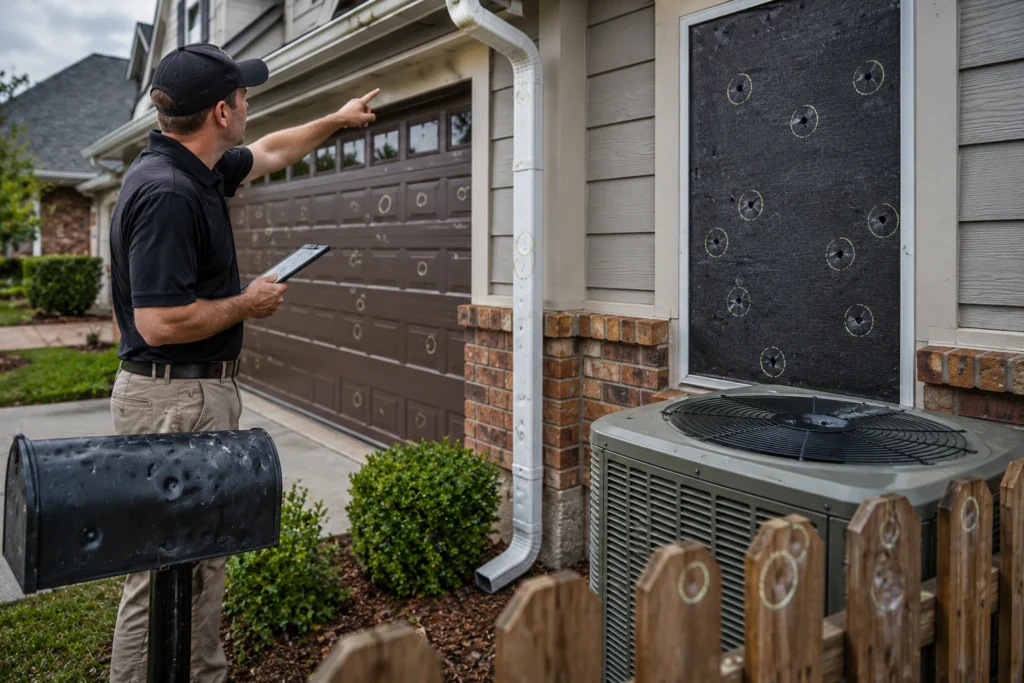
Once on-site, adjusters begin examining the property’s exterior. Rather than immediately climbing onto the roof, they often walk around the home looking for evidence that helps reconstruct what occurred during the storm. Several items receive close attention because they preserve impact marks exceptionally well.
These include:
| Exterior Component | What Adjusters Look For |
| Gutters | Fresh dents and impact marks |
| Downspouts | Directional impacts |
| Garage doors | Circular dents |
| Mailboxes | Surface deformation |
| Window screens | Tears or punctures |
| Air conditioning units | Damaged condenser fins |
| Metal flashing | Fresh indentations |
| Fence caps | Surface impacts |
Damage appearing consistently across multiple surfaces often strengthens the conclusion that hail caused the observed conditions.
Roof Inspections Are the Most Critical Part of the Evaluation
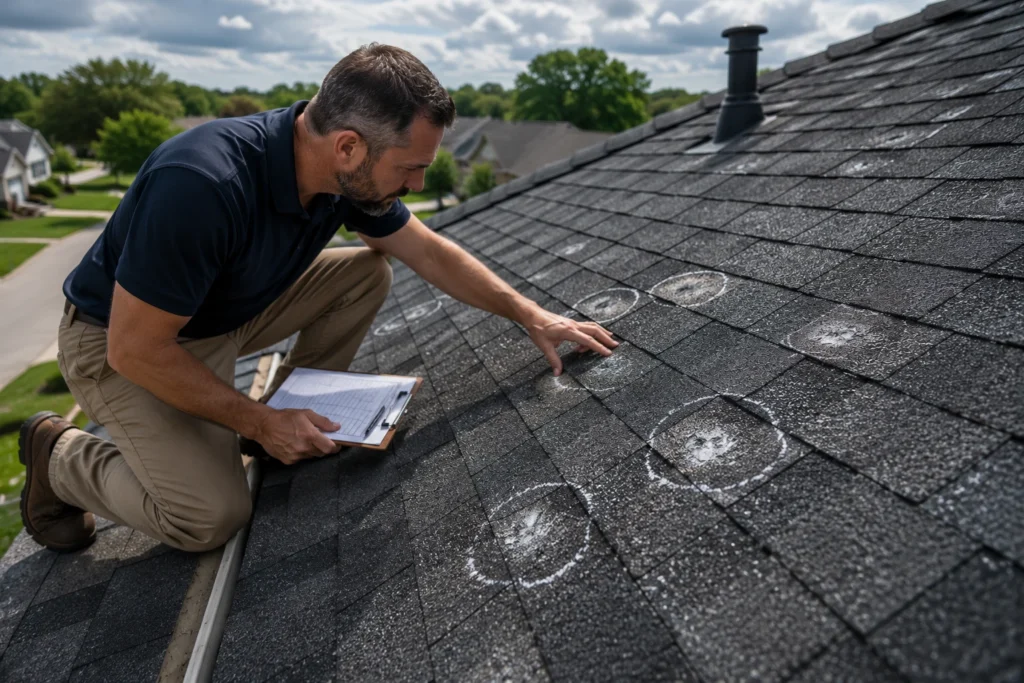
After documenting surrounding evidence, the roof inspection begins. This is where the majority of claim value is usually determined. Contrary to popular belief, adjusters do not simply count damaged shingles.Instead, they evaluate the entire roofing system.
Several areas receive close examination. Roof planes. Ridge caps. Valleys. Roof penetrations. Pipe boots. Roof vents. Drip edges. Flashing. Underlayment conditions when visible. Drainage patterns. The goal is understanding both the extent and functional significance of the damage. Every roofing material responds differently to hail. That is why inspections require experience.
How Asphalt Shingle Roofs Are Evaluated
Asphalt shingles remain the most common residential roofing material across Texas. Consequently, adjusters spend considerable time inspecting them.
Typical signs of hail damage include:
- Granule displacement
- Bruised shingles
- Circular impact marks
- Fractured fiberglass mats
- Exposed asphalt
- Cracked tabs
- Soft spots beneath impacts
Granules serve an important purpose. They protect shingles from ultraviolet radiation while helping regulate surface temperatures. When hail removes enough granules, the underlying asphalt becomes more vulnerable to long-term deterioration. However, not every area of granule loss results from hail. Age. Foot traffic. Manufacturing variations. Wind. Tree debris. Normal weathering. Each possibility must be considered before attributing damage to a recent storm.
Metal Roofs Tell a Different Story
Metal roofing systems react very differently than asphalt shingles. Instead of fractures, hail usually creates dents. The challenge lies in determining whether those dents affect the roof’s performance. Minor cosmetic dents may have little influence on waterproofing. Conversely, severe impacts can deform seams, compromise fasteners, damage protective coatings, or create openings where moisture eventually enters.
Adjusters inspect:
- Standing seams
- Fasteners
- Ridge caps
- Flashings
- Panel joints
- Protective finishes
The overall pattern often reveals how intense the storm truly was.
Tile and Slate Roofing Require Specialized Evaluation
Clay tile, concrete tile, and natural slate behave differently again. These materials tend to crack rather than dent. Unfortunately, some fractures remain difficult to identify without close inspection. Hairline cracks can eventually expand through repeated temperature changes. Water then infiltrates beneath otherwise attractive roofing materials. Because replacement tiles occasionally differ in color or become unavailable years later, adjusters also consider repair feasibility when evaluating older roofing systems.
Flat Roofing Systems Present Unique Challenges
Commercial buildings frequently utilize flat or low-slope roofing systems. Rather than shingles, these roofs often consist of membranes designed to prevent water intrusion across broad surfaces.
Hail can:
- Puncture membranes
- Damage protective coatings
- Separate seams
- Crack insulation boards
- Create hidden moisture intrusion
Unlike residential roofs, many commercial systems require moisture testing or thermal imaging before the full extent of damage becomes apparent. These inspections often continue long after visible surface damage has been documented.
Cosmetic Damage Versus Functional Damage
One of the most misunderstood aspects of how insurance companies evaluate hail damage involves distinguishing cosmetic damage from functional damage. The distinction significantly affects claim outcomes. Cosmetic damage changes appearance. Functional damage changes performance.
Consider the comparison below.
| Cosmetic Damage | Functional Damage |
| Minor dents | Roof punctures |
| Paint scratches | Broken shingles |
| Surface blemishes | Water intrusion pathways |
| Slight discoloration | Membrane failures |
| Small dings | Structural weakening |
Some policies specifically exclude cosmetic damage to certain roofing materials. Others provide broader coverage. Reading the policy carefully helps homeowners understand what protections actually exist before assuming damage qualifies for replacement.
Factors That Influence the Severity of Hail Damage
No two storms produce identical damage. Likewise, no two homes respond exactly the same way. Insurance companies evaluate numerous variables simultaneously before reaching conclusions.
Among the most influential factors are:
- Hailstone diameter
- Wind velocity
- Roof pitch
- Roofing material
- Roof age
- Previous repairs
- Existing deterioration
- Tree protection
- Building orientation
- Surrounding structures
For example, one side of a home may experience substantially greater damage simply because it directly faced wind-driven hail during the storm. Meanwhile, another roof section remained partially protected by neighboring structures or mature trees. Understanding these variables explains why how insurance companies evaluate hail damage requires far more analysis than simply measuring hailstones.
Modern Technology Has Changed the Inspection Process
Roof inspections today look very different than they did even a decade ago. Technology has dramatically improved both documentation and measurement accuracy.
Many insurance companies now use:
- High-resolution drones
- Satellite roof measurement software
- Artificial intelligence damage analysis
- Moisture detection equipment
- Thermal imaging cameras
- Digital estimating platforms
- GPS-enabled inspection reports
These tools allow adjusters to collect thousands of data points during a single inspection while producing highly detailed reports. Technology, however, does not replace professional judgment. It simply provides another layer of objective evidence supporting the evaluation.
Damage Documentation Is More Important Than Many Homeowners Realize
Every insurance claim depends on evidence. Without documentation, even legitimate damage becomes harder to verify. Adjusters therefore create extensive photographic records throughout every inspection.
Typical documentation includes:
- Wide-angle roof photographs
- Close-up impact photographs
- Measurements
- Diagram sketches
- Weather reports
- Material identification
- Repair notes
- Supporting observations
Homeowners should consider creating their own documentation as well. Photographs taken immediately after the storm may capture conditions that later change due to additional weather exposure, temporary repairs, or cleanup efforts. Strong documentation often becomes one of the most valuable assets during the entire claims process.
How Insurance Companies Calculate Repair Costs
Once the inspection is complete, the focus shifts from identifying damage to calculating what it should cost to restore the property. This is another critical stage in how insurance companies evaluate hail damage, and it often determines whether homeowners feel satisfied or frustrated with their settlement.
Insurance companies do not typically estimate repair costs by simply requesting a contractor’s opinion. Instead, most carriers rely on industry-standard estimating platforms that contain extensive pricing databases. These databases are updated regularly to reflect local labor rates, material costs, equipment expenses, and market conditions.
An estimate usually includes several categories of expenses.
- Roofing materials
- Underlayment
- Ridge caps
- Flashing
- Drip edge
- Starter shingles
- Ventilation components
- Labor
- Tear-off and disposal
- Dumpster fees
- Equipment rental
- Permit costs
- Sales tax
The software combines these figures into a detailed repair estimate that serves as the foundation for the insurance company’s payment calculation. Even so, estimates are not always identical. Contractors and insurance adjusters may legitimately disagree about repair methods, local pricing, or whether certain materials should be replaced rather than repaired.
Local Building Codes Can Affect Claim Value
Many homeowners overlook one important factor: building codes. Construction standards change over time. A roof installed twenty years ago may have fully complied with code when it was built, but today’s requirements could be very different.
For example, current codes may require:
- Improved ventilation
- Enhanced underlayment
- Ice and water barriers in certain applications
- Updated flashing methods
- Stronger fastening systems
- Modern drip edge installation
If local regulations require these upgrades during a covered repair, they may increase the total project cost. Whether those additional costs are covered depends largely on the policy. Some insurance policies include ordinance or law coverage, while others provide only limited protection. Understanding these provisions before repairs begin helps prevent unexpected expenses.
Actual Cash Value Versus Replacement Cost
One of the most confusing parts of any insurance claim involves depreciation. Homeowners often expect the first insurance payment to cover the entire cost of replacing the roof. That is not always how the process works.
Two common valuation methods exist.
| Actual Cash Value (ACV) | Replacement Cost Value (RCV) |
| Accounts for depreciation | Pays replacement cost |
| Lower initial payment | Higher total reimbursement |
| Based on age and condition | Based on current pricing |
| Final payment may be lower | Recoverable depreciation may apply |
With Actual Cash Value coverage, the insurance company subtracts depreciation before issuing payment. Replacement Cost policies generally work differently. The insurer often pays an initial amount, withholds depreciation, and releases the remaining funds after repairs have been completed and documentation has been submitted. Knowing which valuation method applies to your policy helps eliminate confusion when the first payment arrives.
Why Two Estimates Can Be Very Different
One of the most common questions homeowners ask is simple. “Why does my contractor’s estimate differ so much from the insurance estimate?” There is no single answer. Several factors contribute to estimate differences. A contractor may identify additional damaged components that were not included during the initial inspection. Material pricing can change. Labor rates fluctuate. One estimate may include code-required upgrades while another does not.
Some contractors recommend replacing complete roof sections for consistency, whereas an insurance estimate may initially allow only localized repairs. These differences do not automatically mean either estimate is incorrect. Instead, they often indicate that additional documentation or discussion is necessary before both parties reach an agreement.
Supplemental Claims Are More Common Than Many People Think
An insurance estimate is not always the final word. During repairs, contractors occasionally discover hidden damage that could not reasonably be identified during the original inspection.
Examples include:
- Wet decking beneath shingles
- Hidden flashing damage
- Moisture-damaged insulation
- Rotten roof sheathing
- Damaged ventilation components
When these conditions are documented properly, contractors may submit a supplemental request to the insurance company. The insurer then reviews the additional information and determines whether those newly discovered repairs qualify under the policy. Supplemental claims are a normal part of many large restoration projects.
Common Reasons Hail Claims Become Underpaid
Not every disagreement results from intentional wrongdoing. In many situations, underpayments stem from incomplete information or differing professional opinions.
Some of the most common causes include:
- Limited inspection time
- Missed collateral damage
- Incorrect roof measurements
- Incomplete repair scopes
- Pricing differences
- Incorrect material identification
- Cosmetic damage classifications
- Missing building code items
- Overlooked detached structures
Small omissions can add up quickly. For example, forgetting to include ridge caps, flashing, drip edge, or ventilation components may significantly reduce the overall estimate even though each individual item appears relatively minor. Carefully reviewing every line item helps homeowners understand exactly what has been included and what has not.
What Homeowners Should Do Before the Adjuster Arrives
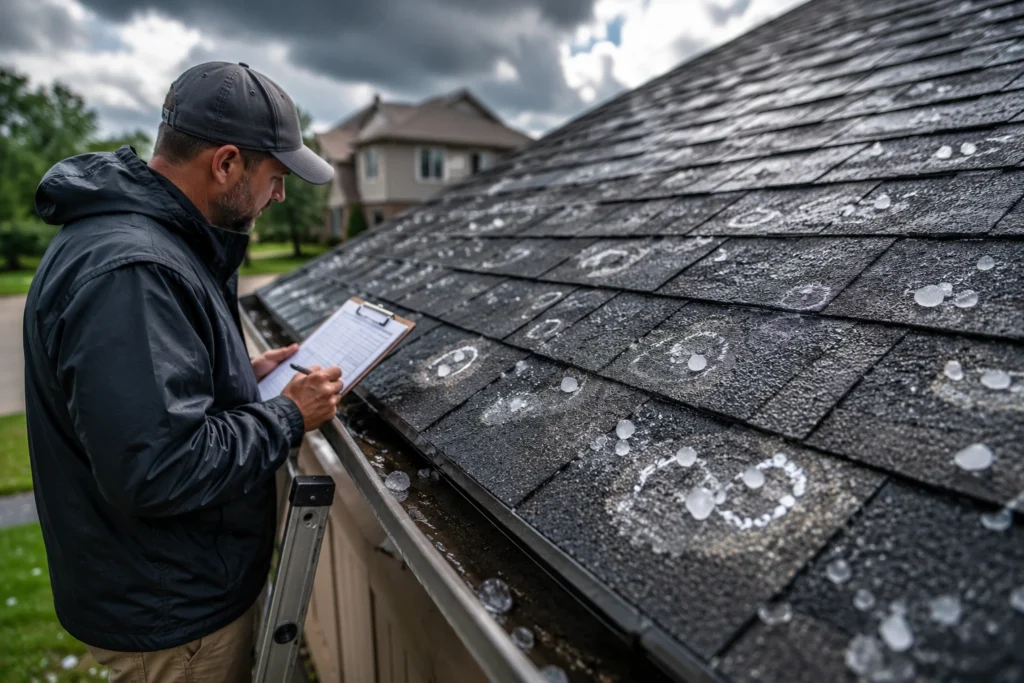
Preparation can make the inspection process much smoother. Rather than waiting until the adjuster arrives, consider gathering important information in advance.
Helpful preparation includes:
- Photograph every visible area of damage.
- Take wide-angle and close-up photographs.
- Record the approximate storm date.
- Save severe weather notifications.
- Keep receipts for emergency repairs.
- Document interior water stains.
- Create a list of damaged exterior items.
- Remove vehicles if they block inspection areas.
- Ensure safe roof access if requested.
These simple steps create an organized record that may prove valuable throughout the claim.
Mistakes Homeowners Should Avoid
Just as good preparation strengthens a claim, certain mistakes can complicate the process. Avoid these common errors whenever possible.
Waiting Too Long
Small roof damage rarely improves with time. Delaying inspections may allow additional deterioration, making it more difficult to determine what damage resulted from the original storm.
Throwing Away Evidence
Broken roof tiles, damaged vents, or dented metal components sometimes become valuable evidence. Do not discard them until repairs have been completed.
Making Permanent Repairs Too Soon
Emergency measures that prevent additional damage are usually appropriate. Permanent repairs completed before documentation, however, may complicate claim evaluations.
Assuming Every Dent Is Covered
Visible dents do not automatically mean replacement is required. Insurance companies evaluate functionality, policy language, and overall damage before determining coverage.
Why Independent Roof Inspections Can Be Beneficial
Although insurance adjusters perform detailed inspections, many homeowners also request an independent roofing evaluation.
A qualified roofing professional may identify:
- Hidden impact damage
- Additional collateral damage
- Ventilation issues
- Flashing problems
- Moisture intrusion
- Code-related concerns
Independent inspections can also provide photographs, measurements, and written reports that complement the insurance company’s documentation. The goal should not be conflict. Instead, multiple professional evaluations often create a more complete understanding of the property’s condition.
The Role of a Public Adjuster
Public adjusters work exclusively for policyholders. Unlike insurance company adjusters, they do not represent the insurer. Instead, they help homeowners understand policy provisions, organize documentation, prepare estimates, review settlement offers, and communicate throughout the claims process.
For homeowners in Euless, this independent representation can be especially valuable when dealing with extensive storm damage or complex claim issues involving multiple structures and significant repair costs. Public adjusters also review whether all covered damages have been properly documented before repairs begin.
Warning Signs Your Claim May Need Additional Review
Most insurance claims are handled professionally. However, homeowners should still review every estimate carefully. Certain situations deserve closer attention.
| Warning Sign | Why It Matters |
| Extremely fast settlement | Damage scope may be incomplete |
| Large contractor estimate differences | Additional review may be needed |
| Missing roof sections | Inspection could be incomplete |
| Significant depreciation | Settlement reduced considerably |
| Missing collateral damage | Some repairs may have been overlooked |
| Repeated inspection delays | Complex issues may remain unresolved |
One warning sign alone does not necessarily indicate a problem. Several occurring together, however, may justify requesting clarification or additional documentation. The Importance of Communication Throughout the Claim Successful insurance claims rarely depend on one inspection alone. Communication plays a major role from beginning to end.
Keep copies of:
- Emails
- Letters
- Inspection reports
- Photographs
- Repair invoices
- Temporary repair receipts
- Contractor estimates
- Payment summaries
Maintaining organized records makes future discussions far easier if questions arise. It also reduces confusion months later when repairs begin. Looking Beyond the Roof Many homeowners focus almost exclusively on shingles. Insurance companies do not. A complete hail damage evaluation considers the entire property.
Additional areas commonly inspected include:
- Gutters
- Downspouts
- Windows
- Window screens
- Garage doors
- Skylights
- Exterior lighting
- HVAC systems
- Deck railings
- Fences
- Pergolas
- Storage sheds
Damage affecting multiple exterior components often provides valuable supporting evidence regarding the overall severity of the storm.
Why Every Property Produces Different Results
Even neighboring homes may receive different settlement amounts. That surprises many homeowners. Several factors explain these differences. Roof age. Construction quality. Previous repairs. Roof orientation. Tree protection. Roofing material. Maintenance history.
Storm direction. These variables influence both the amount of damage sustained and the repair approach necessary to restore the property. That is why how insurance companies evaluate hail damage involves much more than comparing one house to another. Every claim stands on its own evidence.
Final Thoughts
Understanding how insurance companies evaluate hail damage gives homeowners a tremendous advantage before, during, and after the claims process. Instead of wondering why an adjuster inspected gutters, measured roof slopes, photographed air conditioning equipment, or reviewed historical weather reports, you now understand how each piece contributes to the overall evaluation. Insurance companies use a structured process designed to determine whether damage resulted from a covered hail event, how severe that damage is, and what reasonable repairs should cost. While disagreements sometimes occur, well-documented claims supported by detailed inspections and organized records often move through the process more smoothly.
If your property has recently experienced a hailstorm, take the time to document the damage thoroughly, preserve receipts, review your policy carefully, and ask questions whenever something is unclear. Knowledge remains one of the most valuable tools any homeowner can have when navigating a property insurance claim. For property owners in Euless, understanding how insurance companies evaluate hail damage can make the difference between simply accepting an estimate and confidently participating in every stage of the claims process. The more informed you are, the better prepared you’ll be to protect your property and pursue the coverage your policy provides.
FAQs
Insurance companies inspect the roof, gutters, siding, windows, HVAC equipment, and other exterior components to determine the extent and cause of the damage.
They use weather reports, radar data, hail maps, and on-site evidence to confirm that a hailstorm occurred at your property’s location and on the reported date.
It depends on your policy. Some policies cover cosmetic damage, while others only cover functional damage that affects the roof’s ability to protect the home.
Yes. Older roofs may still qualify for coverage if the damage resulted from a covered hailstorm rather than normal wear and tear.
Contractors and insurance adjusters may differ on repair methods, material pricing, code requirements, or the overall scope of the damage.
Actual Cash Value subtracts depreciation from the payout, while Replacement Cost Value reimburses the cost of replacing damaged materials, subject to your policy terms.
Yes. Taking clear photos immediately after the storm helps document the damage and provides valuable evidence during the claims process.
Yes. Contractors sometimes uncover concealed damage beneath roofing materials, which may be submitted to the insurer as a supplemental claim.
A public adjuster can help review your policy, document damages, and negotiate with the insurance company, especially for complex or high-value claims.
The deadline varies by policy and state law, so review your insurance policy and report the damage as soon as possible after the storm.